
News
Tesla Full Self-Driving v14.1 first impressions: Robotaxi-like features arrive
Tesla Full Self-Driving v14.1 is here, and we got to experience it for ourselves.

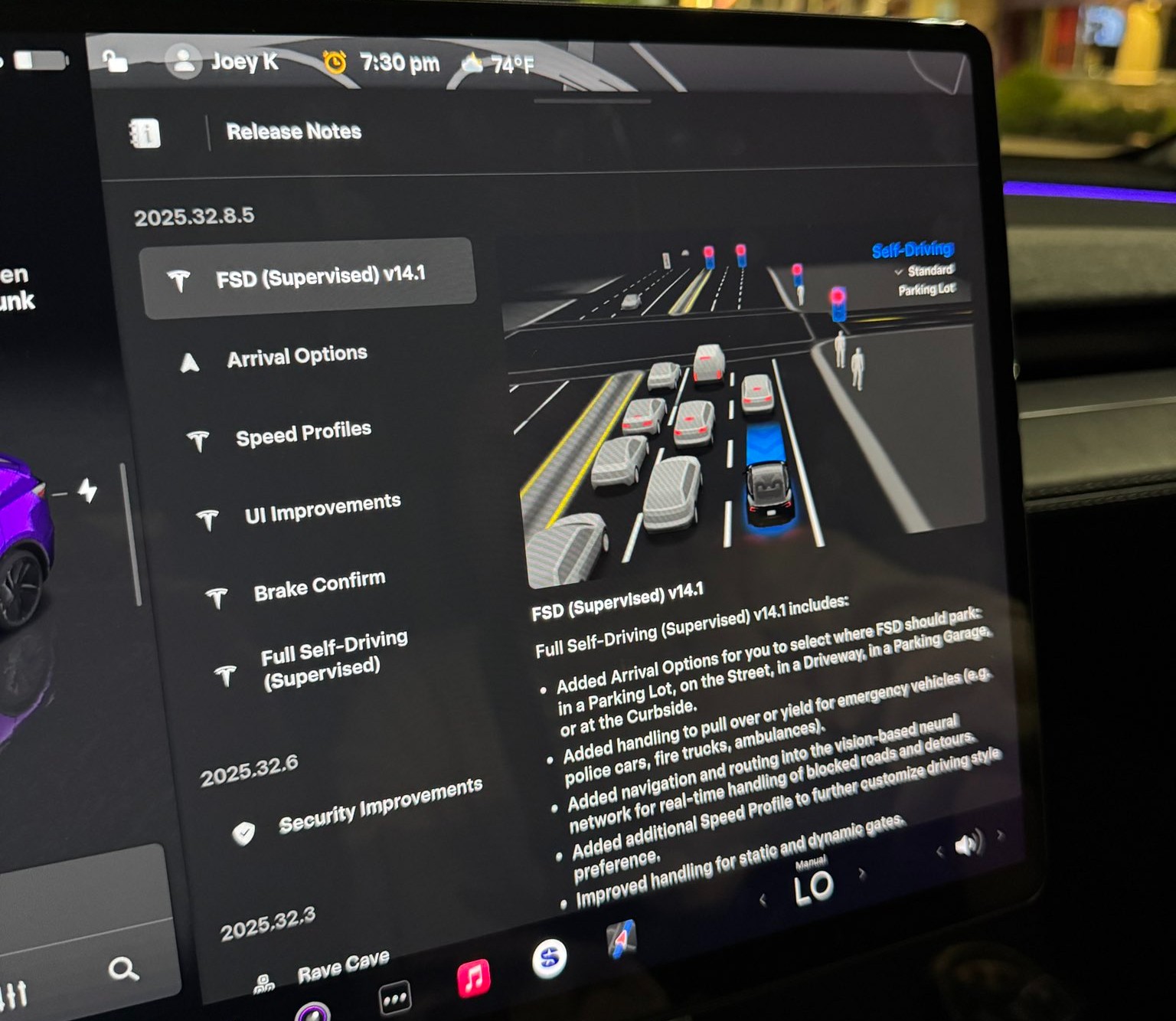
Tesla rolled out its Full Self-Driving v14.1 yesterday, its first public launch of its most robust and accurate FSD iteration yet. Luckily, I was able to get my hands on it through the Early Access Program.
The major changes in FSD v14.1 were revealed in the release notes, which outline several notable improvements in areas such as driving styles, parking, and overall navigation. Here’s what Tesla outlined fully in its release notes:
- Added Arrival Options for you to select where FSD should park: in a Parking Lot, on the Street, in a Driveway, in a Parking Garage, or at the Curbside.
- Added handling to pull over or yield for emergency vehicles (e.g. police cars, fire trucks, ambulances).
- Added navigation and routing into the vision-based neural network for real-time handling of blocked roads and detours.
- Added additional Speed Profile to further customize driving style preference.
- Improved handling for static and dynamic gates.
- Improved offsetting for road debris (e.g. tires, tree branches, boxes).
- Improve handling of several scenarios including: unprotected turns, lane changes, vehicle cut-ins, and school busses.
- Improved FSD’s ability to manage system faults and recover smoothly from degraded operation for enhanced reliability.
- Added alerting for residue build-up on interior windshield that may impact front camera visibility. If affected, visit Service for cleaning!
I wanted to try it for myself. My big must-dos were my complaints with v13.2.9, which included parking when arriving at a destination, Navigation when leaving a destination, and definitely a general improvement in the car traveling at an acceptable rate of speed, even when using the “Hurry” driving style.
Here’s what I noticed with the new Full Self-Driving v14.1:
Speed Profiles are More Realistic
I am driving on “Hurry” about 95% of the time when utilizing Full Self-Driving. In past versions, most notably v13.2.9, my Tesla would slowly reach the speed limit, and it would tend to hang out at about 1-2 MPH either above or below it.
My first observation with v14.1 was the vehicle’s tendency to get right up to speed and, since I was still on Hurry, drive slightly above the speed limit. It never got out of line; it traveled at speeds I would typically drive at manually.
I think this is a big improvement on its own, because I felt that I was pressing the accelerator too frequently in past FSD versions. Oftentimes, it just wasn’t going fast enough to justify the “Hurry” label; it felt more conservative and more like a student driver than anything.
Check it out:
🚨 Tesla Full Self-Driving v14.1 travels at more realistic speeds on local roads.
With 13.2.9, even on Hurry, it would hover the speed limit a little too much, often times traveling 1-2 MPH below or over.
It now travels at more realistic speeds. The removal of Max Speed and… pic.twitter.com/DPC0oBl3SC
— TESLARATI (@Teslarati) October 8, 2025
This was among my favorite improvements, and it was the first thing I noticed as the car navigated me to the Supercharger, where my next positive is.
Navigating into parking lots, self-parking at Supercharger
One of the changes noted in the Release Notes was the addition of Arrival Options, which allows the car to select the appropriate parking situation. Since I was going to charge, the car had already chosen “Charger” as the parking option.
Pulling into a gas station or convenience store, especially during work days, can be stressful, as they are usually congested and full of foot and vehicle traffic. In past FSD versions, I have noticed the car being slightly “jumpy” and even hesitant to proceed through the lot.
Driving through parking lots was a noticeable improvement. It seems as if the car is much more confident in making its way through, while still being aware and cautious enough to safely navigate to the Supercharger.
It then backed straight into a Supercharger stall, which was recently repaired and is once again active. I was actually upset it chose this specific stall because it had been inactive for a while. However, Tesla got this stall back up and running, the car chose it, and backed into the spot flawlessly:
🚨 Check out Tesla Full Self-Driving v14 choosing and backing into a Supercharger
After selecting this Supercharger at the beginning of my trip, my Tesla had already selected “Charger” as the arrival option pic.twitter.com/jqLNwQ9x0o
— TESLARATI (@Teslarati) October 8, 2025
This was super cool to experience, and I think it is a testament to how hard the Tesla AI team has worked. CEO Elon Musk recently stated that FSD would enable automatic parking at Superchargers, which was really awesome to experience firsthand.
I decided to leave the Supercharger and go to an auto parts store to pick up some interior cleaner and some microfiber towels. I love keeping my Tesla clean!
I also thought it would be a great opportunity to see how it would react to another parking lot, how it would navigate it, and let it choose a parking spot. It did it all flawlessly:
🚨 Here’s Tesla Full Self-Driving v14.1 navigating to a store, pulling in, choosing a parking spot, and backing right in
From v13.2.9, this is a drastic improvement. Typically, manual parking was required in past versions when arriving at retail locations. pic.twitter.com/kgFMu6dxnW
— TESLARATI (@Teslarati) October 8, 2025
I had zero complaints about everything here. All of it was done really well.
Making a choice after being caught in the middle of an intersection
I arrived at a tight intersection in Dallastown, PA, and what my car did next has catalyzed quite a conversation on X.
It proceeded out into the middle of the intersection as the light was green. It had to yield to oncoming traffic, and while waiting, the light turned yellow, then red.
Most people, including myself, would have turned right and proceeded through the intersection since the car was already past the line. However, FSD chose to back up and wait for the next light cycle, which I felt was also a more than acceptable option:
🚨 Super cool thing Tesla FSD v14.1 did: it proceeded thru this intersection to turn left, but the light had gone to red before the turn could be completed.
It put itself in reverse and backed up to the “Stop Here on Red” sign/line. Didn’t proceed at a red or impede others. pic.twitter.com/AKb1AI32fK
— TESLARATI (@Teslarati) October 8, 2025
There are some conflicting perspectives on what it chose to do here. Some said they would have proceeded and would want FSD to also proceed. I can agree with that perspective, but I also think it is not the worst thing in the world to back up. In Pennsylvania, I couldn’t find the exact law that says what is right or wrong. Instead, I did see that a left turn on red is only feasible when you’re going from a One-Way street to another One-Way.
I’m not totally sure what is “correct” here, but I think either option is fine. I have personally done both, and I’ve seen other drivers do both. I was more than fine with the car doing this, and I was honestly impressed that it did.
Navigated a busy grocery store lot, found suitable parking
This is not the busiest my local grocery store gets, but it was still congested enough for me to be impressed.
FSD decided to do one loop in the parking lot before it found a spot that it felt was good enough for me. I was perfectly fine with where it chose to park, and I thought it did a really great job. I was impressed with how stress-free I felt, as I have noted in the past that parking lots are definitely an area where Tesla needs to improve.
I was happy with its performance:
🚨 Here, @Tesla Full Self-Driving v14.1 searched for a parking space at the grocery store.
It did one loop, navigating safely through pedestrians and carts before it decided this spot was good enough for me.
This truly will take the stress out of parking at busy stores pic.twitter.com/73U3Bl7Odm
— TESLARATI (@Teslarati) October 8, 2025
Strange right turn signal as if it saw an emergency vehicle
This was the first bug I noticed with FSD v14.1. While traveling on a local road, it put the right turn signal on and approached the curb as if it was pulling over for an emergency vehicle or as if it was going to park on the street.
It then realized its mistake and proceeded:
Now for a couple bugs 🐞
Tesla FSD v14.1 put its right turn signal on as if it was going to pull over. It did move closer to curb, but then realized this wasn’t the correct maneuver for our route.
It proceeded without much issue pic.twitter.com/yoUoyzWMDM
— TESLARATI (@Teslarati) October 8, 2025
I’m not super sure what caused this, but I was a tad bit confused. There were no police cars, ambulances, or anyone with flashing lights to my rear. There was a dump truck on the other side of the road, and I almost felt like the way it navigated “around” that was probably what triggered it.
Navigation is still making strange decisions
I’ve written about navigation and my discontent with some of its decisions. It seems v14.1 didn’t resolve much of anything with navigation, and it did a couple of things wrong.
The first was that it tried to take the illogical and pointless path out of the Supercharger. I wrote about this a few days ago, as FSD tried to take my car the wrong way.
It did it again, but I overrode the decision, and it was all okay:
Bug 🐞 no. 3: I have this issue at this Supercharger and I talk about it frequently.
Navigation takes illogical and strange exit from Supercharger. I override, turning left instead of right, Nav adjusts and picks correct routing. Hoping this is resolved soon. pic.twitter.com/4VsCGHZbYW
— TESLARATI (@Teslarati) October 8, 2025
This is a minor issue, but it is still pretty frustrating. Hopefully, the navigation will learn after performing this adjustment after enough times.
The next navigation issue was more frustrating than the Supercharger one, especially considering it completely ignored the route. The navigation had the vehicle very clearly heading straight, but out of nowhere, the right turn signal went on. I overrode it, but the car still turned right, ignoring the navigation completely:
Bug 🐞 no. 2: Navigation clearly shows the route continuing straight through the traffic light. I noticed the right turn signal coming on, so I overrode it.
The car turned right anyway. I took over and drove manually until I was able to get to a stop so I could re-activate FSD pic.twitter.com/nxt4UlRqkK
— TESLARATI (@Teslarati) October 8, 2025
I ended up taking over here and driving until I could get to a stop sign.
Final Thoughts
I am really impressed with all of the changes Tesla made with FSD v14.1, and while there were a handful of bugs, things were tremendously better than v13.2.9.




Elon Musk
Elon Musk just roasted Sam Altman’s Tesla Roadster cancellation
“And you forgot to mention act 4, where this issue was fixed and you received a refund within 24 hours.
But that is in your nature.”
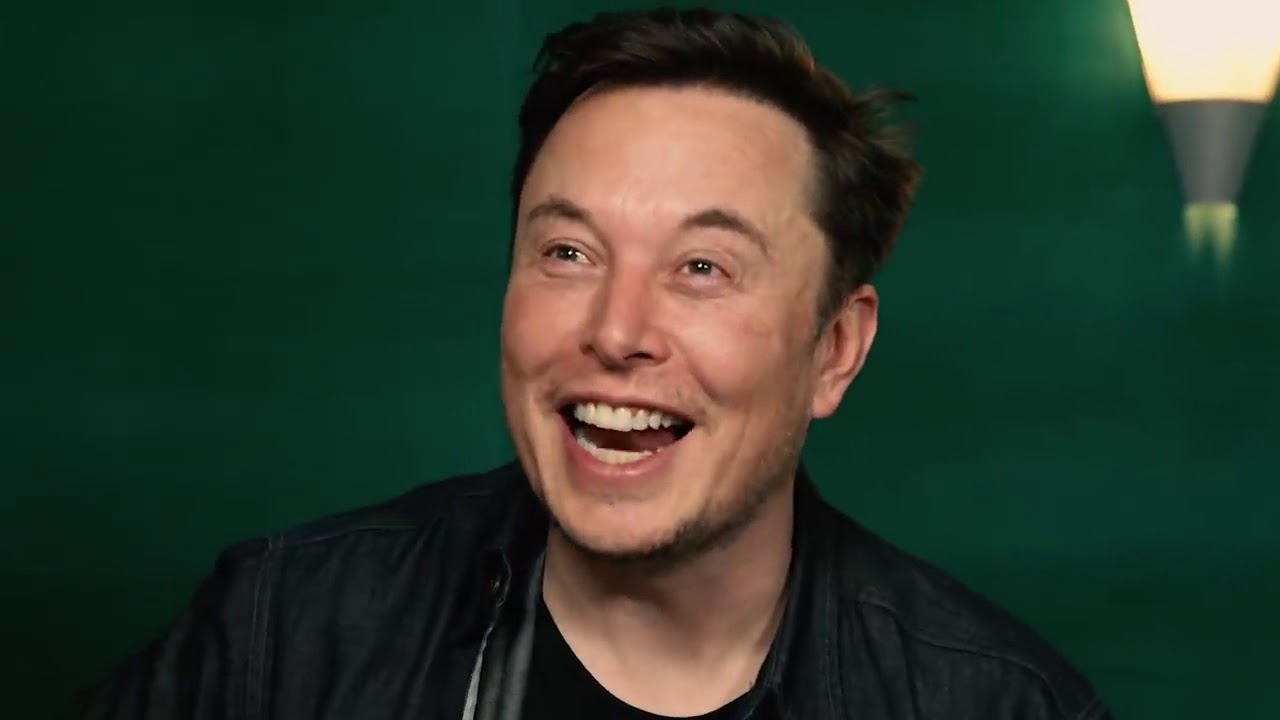
Elon Musk has responded to OpenAI CEO Sam Altman’s decision to cancel his Tesla Roadster reservation, which he revealed on X on Thursday.
We reported on Altman’s decision, which he called “A tale in three acts,” showing his confirmation email from Tesla back in 2018, an email requesting his $50,000 deposit back after canceling his order, and a notification from Google that the email he sent was not delivered.
A tale in three acts: pic.twitter.com/ClRZBgT24g
— Sam Altman (@sama) October 30, 2025
Musk did not take too kindly to the post from his tech rival, first referencing his position with OpenAI, and then confirming that Altman received his reservation deposit back within 24 hours:
And you forgot to mention act 4, where this issue was fixed and you received a refund within 24 hours.
But that is in your nature.
— Elon Musk (@elonmusk) November 1, 2025
OpenAI was started by Musk, Altman, and others back in 2015, and was geared toward being a non-profit company that would develop safe artificial intelligence that would be accessible to people.
However, Musk and Altman did not agree on the future of the company. Musk left, and Altman turned OpenAI into a for-profit company. This led to a variety of lawsuits and some very public spats between the two. Musk has called out Altman for turning the company into a for-profit, which has been his main source of criticism for his former colleague.
The Roadster has been hanging in the balance of Tesla’s manufacturing plans for seven years, but the company has made more indications that it will be unveiled later this year and will have some insane technologies.
Musk said on Friday in an episode of the Joe Rogan Experience Podcast that Tesla is “getting close to demonstrating the prototype.”
He said:
“Whether it’s good or bad, it will be unforgettable. My friend Peter Thiel once reflected that the future was supposed to have flying cars, but we don’t have flying cars. I think if Peter wants a flying car, he should be able to buy one…I think it has a shot at being the most memorable product unveil ever. [It will be unveiled] hopefully before the end of the year. You know, we need to make sure that it works. This is some crazy technology in this car. Let’s just put it this way: if you took all the James Bond cars and combined them, it’s crazier than that.”
Musk hinted that the vehicle could fly and would have “crazy technology” that would put James Bond’s vehicles to shame. It will be interesting to see what Tesla will unveil when the event happens and if it can come through on this mind-blowing teaser.
News
SpaceX successfully launches 100th Starlink mission of 2025
With 100 Starlink missions completed for 2025, space enthusiasts have noted that SpaceX has successfully launched 2,554 Starlink satellites so far this year.

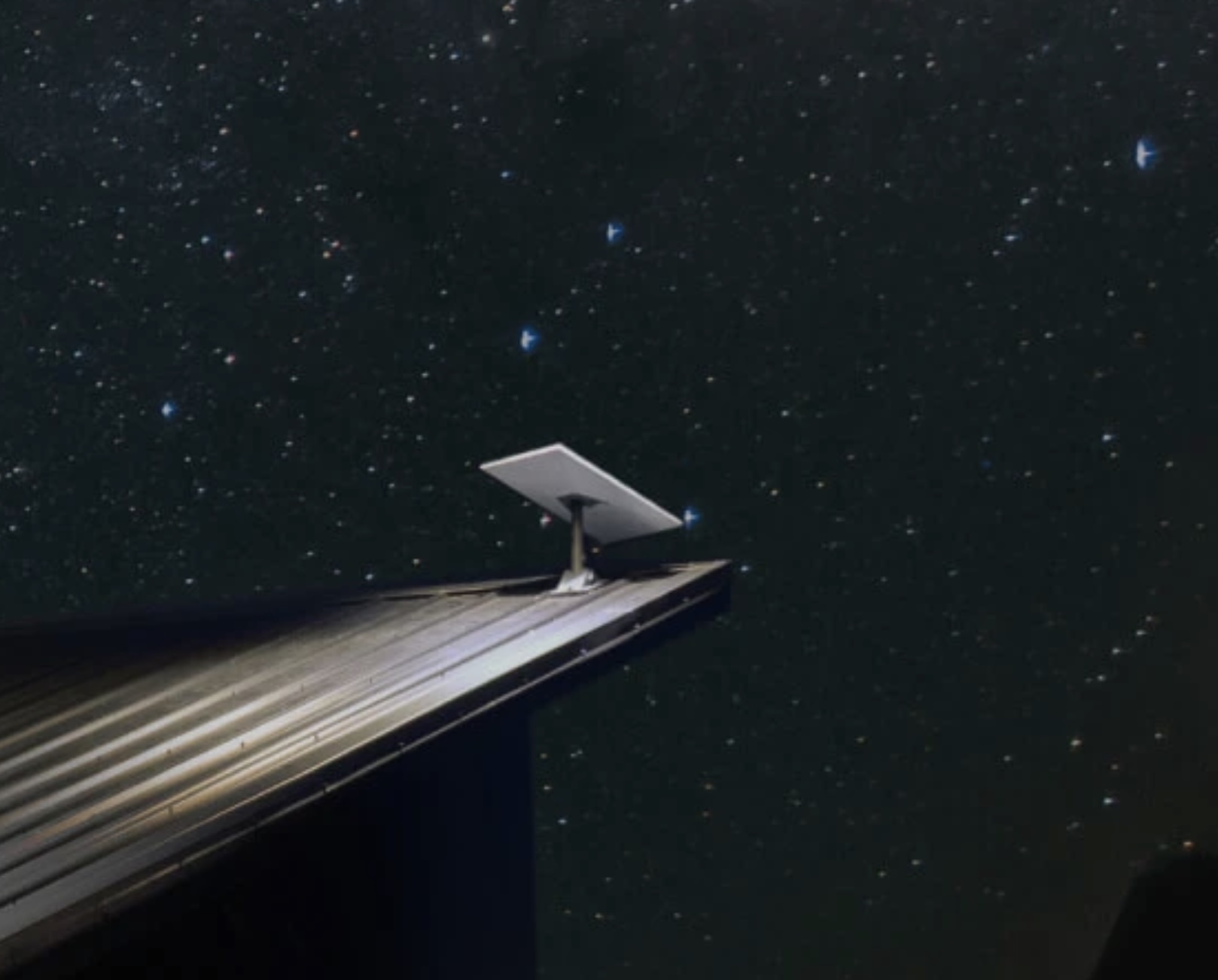
SpaceX achieved its 100th Starlink mission of the year on Friday, October 31, marking another milestone for 2025.
A Falcon 9 rocket carrying 28 Starlink broadband satellites successfully lifted off from Vandenberg Space Force Base in California at 4:41 p.m. ET, carrying another 28 Starlink satellites to Low Earth Orbit (LEO).
Falcon 9 booster’s 29th flight
Roughly 8.5 minutes after liftoff, the Falcon 9’s first stage touched down on the drone ship Of Course I Still Love You in the Pacific Ocean. This marked the booster’s 29th flight, which is approaching SpaceX’s reuse record of 31 missions.
This latest mission adds to SpaceX’s impressive 138 Falcon 9 launches in 2025, 99 of which were dedicated to Starlink, according to Space.com. The company’s focus on reusing boosters has enabled this breakneck pace, with multiple launches each week supporting both Starlink’s expansion and external customers.
Starlink’s network continues massive global expansion
Starlink remains the largest active satellite constellation in history, with more than 10,000 satellites launched, nearly 8,800 of which are currently active. SpaceX recently achieved Starlink’s 10,000-satellite milestone. With 100 Starlink missions completed for 2025, space enthusiasts have noted that SpaceX has successfully launched 2,554 Starlink satellites so far this year.
Starlink, which provides high-speed, low-latency internet connectivity even to the world’s most remote areas, has been proven to be life-changing technology for people across the globe. The service is currently operational in about 150 countries, and it currently has over 5 million subscribers worldwide. From this number, 2.7 million joined over the past year.
News
Tesla shares updated timeframe for Cybertruck FSD V14 release
The Cybertruck was expected to receive FSD V14 before the end of the month, but Tesla was not able to meet the target.
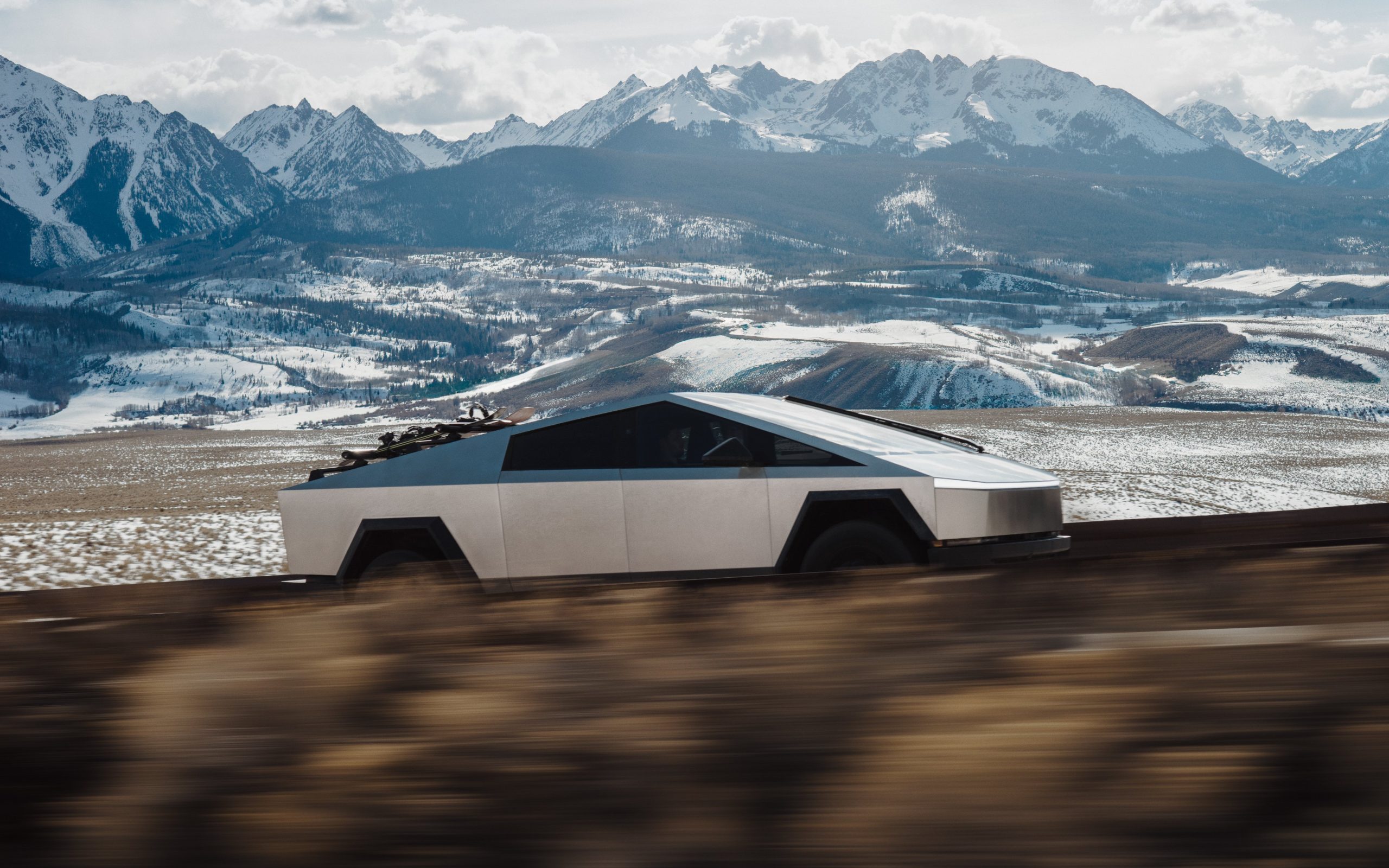
Tesla’s Full Self-Driving (FSD) V14 update for the Cybertruck could arrive this weekend, as per recent comments from Director of Autopilot Software and VP of AI Ashok Elluswamy.
The Cybertruck was expected to receive FSD V14 before the end of the month, but Tesla was not able to meet the target.
Cybertruck FSD V14
Considering the extended wait for FSD V14, it was no surprise that several Cybertruck owners were asking for updates about the system’s rollout to the all-electric pickup truck on Friday. These included the official Cybertruck X account, which responded to Elluswamy’s end of month estimate with “I only see trick. Where is my treat.”
This prompted a response from the AI executive, who replied with, “Sorry, pushing for early access Cyber release over the weekend.” This means that if all goes well, Cybertruck owners would be able to experience FSD V14 very soon. Some, however, are wondering if Tesla would go straight to V14.2 for the Cybertruck’s FSD V14 update, or if the vehicle will receive V14.1 first.
Tesla pushes to unify FSD experience across its lineup
The upcoming Cybertruck rollout represents the next step in Tesla’s efforts to roll out FSD capabilities across all of its vehicles. FSD V14 is a notable step forward for the company’s AI-driven self driving system, with features like Mad Max mode getting positive reviews from longtime Full Self Driving testers.
For the Cybertruck, the FSD V14 update would mark one of its first major over-the-air upgrades for the vehicle. Likely due to its size, the Cybertruck tends to receive FSD updates later than the S3XY lineup, which is quite surprising considering that the all-electric pickup truck is a premium-priced vehicle that is home to some of Tesla’s most advanced technologies.

Elon Musk just roasted Sam Altman’s Tesla Roadster cancellation

SpaceX successfully launches 100th Starlink mission of 2025

Tesla shares updated timeframe for Cybertruck FSD V14 release


-
 News2 weeks ago
Elon Musk confirms Tesla FSD V14.2 will see widespread rollout
-
 News2 weeks ago
Tesla might be doing away with a long-included feature with its vehicles
-
 News2 weeks ago
Tesla updates fans on its plans for the Roadster
-
 Elon Musk2 weeks ago
Elon Musk: Grok 5 now has a 10% chance of becoming world’s first AGI
-
 News2 weeks ago
Tesla is ramping up its hiring for the Cybercab production team
-
 News2 weeks ago
Multiple Tesla Cybercab units spotted at Giga Texas crash test facility
-
 Elon Musk2 weeks ago
Tesla will launch driverless rides in Las Vegas, but not where you think
-
 News2 weeks ago
Tesla rolled out a new feature with FSD v14 to fix a major complaint